
Indian Nuclear Submarine Capabilities
Total View : 594 Date 27 Jan 2026
Indian Nuclear Submarine Capabilities
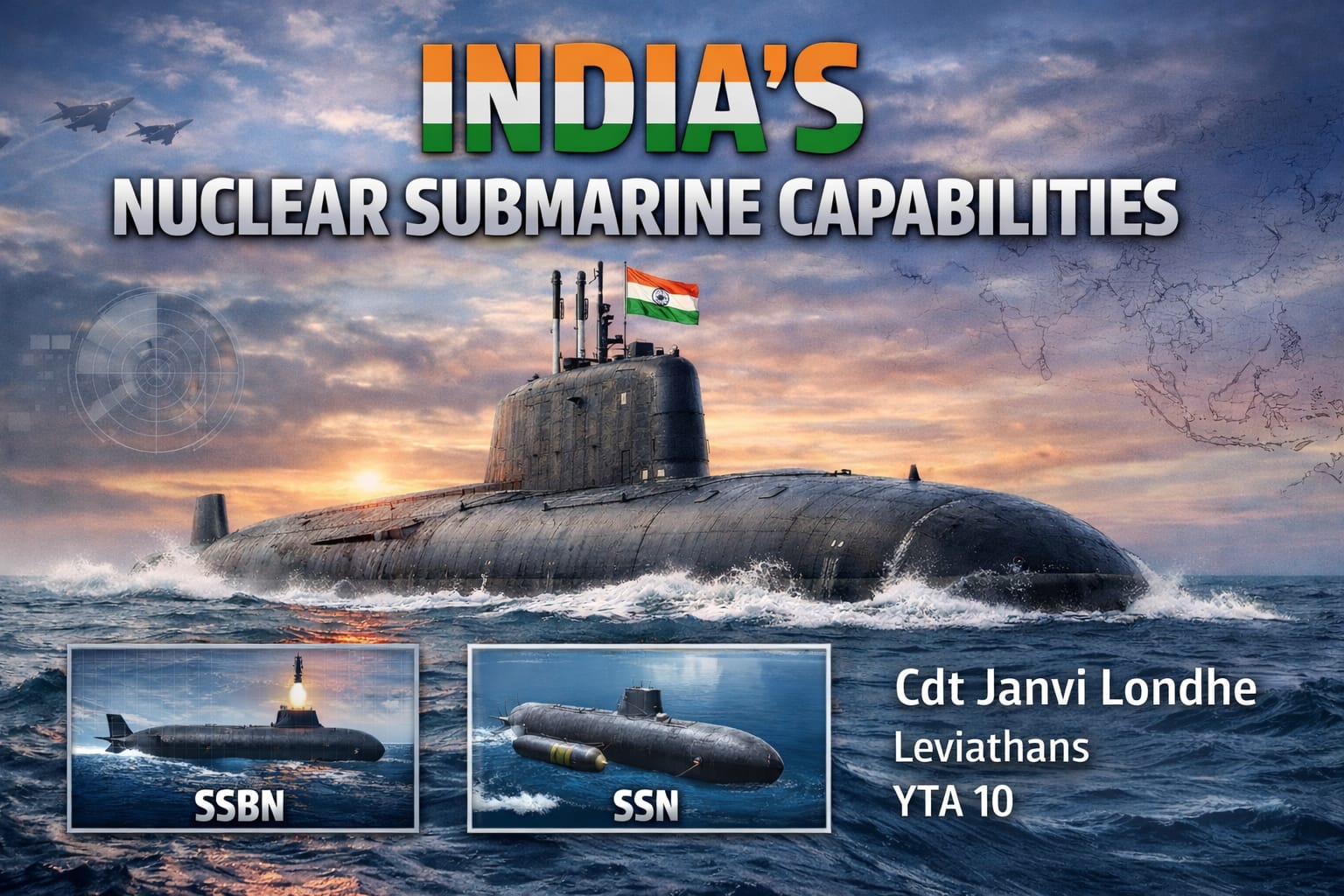
India’s nuclear submarine capability is a crucial component of its national defence system. It significantly strengthens maritime security and establishes India as a major naval power in the Indian Ocean region. Through the development of nuclear-powered submarines, India has joined a small group of technologically advanced nations. Nuclear submarines are powered by nuclear reactors, which allow them to remain underwater for extended periods without surfacing. This provides them with far greater endurance, speed and stealth when compared to diesel-electric submarines.
There are two main types of nuclear submarines. SSBNs, or Nuclear Ballistic Missile Submarines, carry nuclear missiles and form the backbone of strategic deterrence. SSNs, or Nuclear Attack Submarines, are designed to hunt enemy submarines and engage surface ships.
Diesel submarines operate using diesel engines and batteries and must surface periodically to recharge, which limits their underwater endurance. Nuclear submarines, on the other hand, use nuclear reactors, enabling them to remain submerged for months with virtually unlimited range and sustained high speed. Although nuclear submarines are far more expensive, they are strategically far more powerful than diesel submarines.
India’s nuclear submarine programme is being developed under the Advanced Technology Vessel (ATV) project, led by the Indian Navy. The most significant achievement of this programme is INS Arihant, India’s first indigenously built nuclear-powered ballistic missile submarine, which was commissioned in 2016.
India currently operates around nineteen submarines, of which approximately sixteen are conventional diesel-electric attack submarines, such as the Scorpene, Kilo and Shishumar classes, while three are nuclear submarines dedicated to strategic deterrence.
India is also developing additional submarines under the Arihant class, including INS Arighat, which incorporates improved technology and enhanced capabilities. Earlier, India operated INS Chakra, a nuclear-powered attack submarine leased from Russia. This vessel played an important role in crew training and in gaining operational experience in nuclear submarine operations.
INS Chakra, a Russian-made nuclear-powered submarine, was leased to India to strengthen its naval nuclear capability and train personnel in operating such platforms. After the lease period ended, India returned the submarine to Russia in 2021, in accordance with the agreement, while continuing defence cooperation and pursuing indigenous nuclear submarine development.
India’s nuclear submarines are strategically vital in completing its nuclear triad, which refers to the ability to launch nuclear weapons from land, air and sea. This provides a survivable sea-based second-strike capability, deters aggression, ensures credible minimum deterrence and enhances India’s strategic autonomy.
India’s neighbouring countries vary significantly in their naval nuclear capabilities. China is the most important neighbour in this context, operating a large fleet of nuclear submarines that includes both SSBNs and SSNs. China’s expanding presence in the Indo-Pacific and Indian Ocean region poses a strategic challenge to India. Pakistan, however, does not possess nuclear-powered submarines and relies primarily on diesel-electric submarines, largely acquired from China.
India remains the only country in South Asia with operational nuclear ballistic missile submarines, giving it a significant strategic advantage in the region. While China continues to be a formidable competitor, India’s growing nuclear submarine fleet strengthens national security and contributes to regional stability. Continued development in this field will further reinforce India’s position as a leading maritime power.
Cdt Janvi Londhe
Leviathans
YTA 10
© Yashotej Academy